South African Owls
Owls are birds of prey and most of them hunt at night. All owls have acute hearing and good vision which makes the South African Owls some of the best hunting raptors in the country. The Owl species are some of the more beautiful birds in the birds of prey family. Below is a list of the known 12 kinds of Owl species found in South Africa!
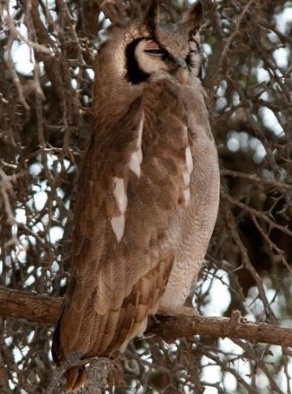
Verreaux's (Giant) Eagle-Owl
Description: Verreaux's Eagle-Owl ranges from 66–75 cm in length. This species can attain a wingspan 2 m and weighs from 1600 to 3115 grams. In appearance, they are distinguished by a whitish oval disk face with a black border, pink eyelids, orange eyes and two feather tufts on their ears. Their feathers are dark brown on top and light grey below.
Behaviour: They are nocturnal birds and roost in tall trees. They sleep lightly and will awaken very quickly to defend themselves from attack in daylight hours.Food: They hunt in early evening. Full-grown owls feed on hares, mongoose, guinea fowl and many other small game animals. They are one of the very few birds to feed on hedgehogs. Near cities their prey include rats and pigeons.
Breeding: Breeding takes place from March to September. The female lays two eggs and incubates them for thirty-eight days. She remains on the nest for the entire incubation period while the male hunts for food for both of them. The first egg to hatch is the first to be fed, and if food is not plentiful only the first one hatched will be fed. If food is abundant, both owlets will be fed. The chicks are ready to leave the nest at nine weeks but may remain with the parents for up to three months.
 Pel's Fishing Owl
Behaviour: The species prefers slow moving rivers with large overhanging trees to roost and forage from. It nests in hollows and the forks of large trees.
Food: It feeds nocturnally on fish and frogs snatched from the surface of lakes and rivers.
Breeding: Though two eggs are laid, only one chick is raised.
 Cape Eagle Owl
Description: The Cape Eagle-Owl (Bubo capensis) is a species of owl in the Strigidae family. It is found in Eritrea, Ethiopia, Kenya, Lesotho, Malawi, Mozambique, Namibia, South Africa,Swaziland, Tanzania, and Zimbabwe. There are three subspecies: capensis (South Africa and extreme southern Namibia),mackinderi (western Mozambique and Zimbabwe to west-central Kenya), and dilloni (the Ethiopian highlands and southern Eritrea). The distribution of all three is patchy. The subspecies mackinderi, which is slightly bigger than the others, is sometimes split as Mackinder's Eagle-Owl, Bubo mackinderi.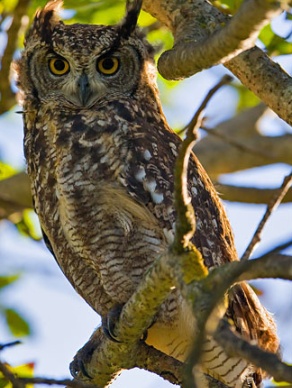
Spotted Eagle Owl
Description: The Spotted Eagle-Owl (Bubo africanus) is a medium-sized species of owl, one of the smallest of the Eagle owls. Its height is 45cm and its weight is from 480 to 850g. It has a 100cm to 140 cm wingspan.
Behaviour: They make their nest on the ground and have been known to nest on window ledges of buildings.Food: Its prey consists of small mammals, birds, insects, frogs, and reptiles. It often swallows quite large prey whole, with much head-jerking, and if the object is really challenging, pausing and resting with the mouth full.
Breeding: Spotted Eagle-Owls mate for life.They are able to breed at around one year of age. Breeding begins in July continuing to the first weeks of February. The female lays two to four eggs and does the incubation, leaving the nest only to eat what the male has brought food. The incubation period lasts approximately 32 days. The young owls can fly at around seven weeks of age. Five weeks later, the young owls leave the nest.
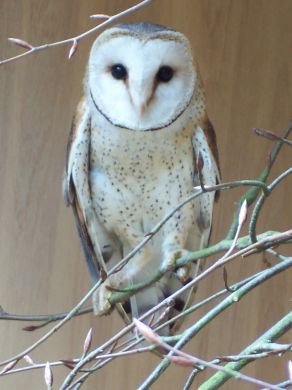
Barn Owl
Description: The Barn Owl is a pale, long-winged, long-legged owl with a short squarish tail. Depending on subspecies, it measures about 25–45cm in overall length, with a wingspan of some 75–110cm. The tail shape is a way of distinguishing the Barn Owl from true owls when seen in flight, as are the wavering motions and the open dangling feathered legs.Food: The Barn Owl feeds primarily on small vertebrates, particularly rodents. Studies have shown that an individual Barn Owl may eat one or more rodents per night; a nesting pair and their young can eat more than 1,000 rodents per year.
Breeding: The breeding season usually starts in late March to early April. Breeding can take place at any time prey is abundant, and in the warm parts of its range may occur at any time of the year. The female typically lays four to seven eggs. The male brings food to the nest as the female incubates the eggs and cares for chicks.
 African Grass-Owl
Description: The African Grass Owl Tyto capensis is considered Vulnerable in South Africa, with between 1 000 and 5 000 birds remaining in this country (Barnes (ed.), 2000). The species is extirpated in south-western South Africa and Lesotho, and the combined pressure from development; fire mismanagement; land clearing for agriculture; overgrazing; afforestation and roadkill are of serious concern for the species (Ansara, 2004). Grass Owls differ in appearance from their cousins the Barn Owl in being larger, with stronger contrast between the upper and lower body. The upperparts are dark brown and the underparts whitish. The face is also rounder than that of the Barn Owl.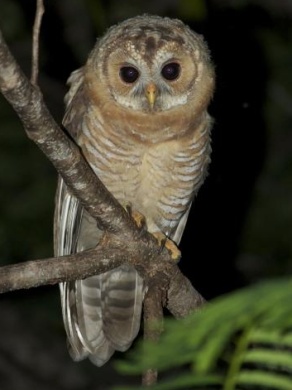
African Wood Owl
Description: The African Wood Owl, Strix woodfordii, is a medium-sized owl with dark eyes and no ear tufts. It is 30 to 36 cm long and weighs from 240 to 350 grams. Its call is a loud series of fast hoots. It is not threatened and is common in almost all of its range.Behaviour: It lives mainly in forest and woodland though it sometimes inhabits plantations.Food: It eats mostly insects but will also eat reptiles, small mammals, and other birds.
Breeding: It breeds from July to October and lays 1 to 3 eggs in a hollow in a tree. It will then incubate the eggs for about 31 days. Five weeks after the eggs hatch, the young will leave the nest and can fly 2 weeks later. The young will remain with the parents for about four months and will sometimes stay till the next breeding season.
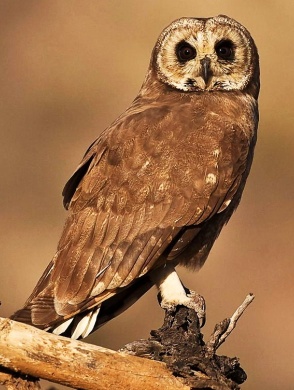
Marsh Owl
Description: The Marsh Owl, Asio capensis, is a species of owl which is a mainly resident breeder in Africaand Madagascar. This species is a part of the larger grouping of owls known as typical owls, Strigidae, which contains most species of owl. The other grouping is the barn owls, Tytonidae. The Marsh Owl is 35-37 cm in length with an 82-99 cm wingspan. It is similar to the slightly larger Short-eared Owl.Behaviour: It hunts over open country, often by day.
Food: Its food is mainly insects, but it will take small mammals, such as rodents and birds.
Breeding: Marsh Owl nests on the ground on open marshy areas, laying 2-4 eggs amongst tussocks.
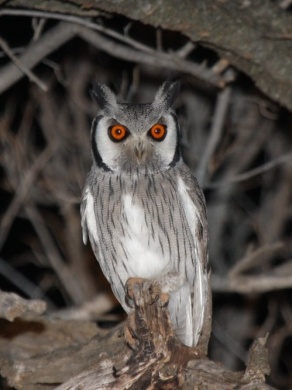
Southern White-Faced Scops-Owl
Behaviour: The owl has the unique ability to modify its appearance in times of danger or threat. It may enlarge its body to ward off other owls, or it may make itself appear shrivelled to camouflage itself as a tree trunk or branch.
Breeding: The eggs are usually laid in the old nest of another bird. The clutch contains two or three eggs which are incubated for about 30 days. The young birds leave the nest about a month after hatching.
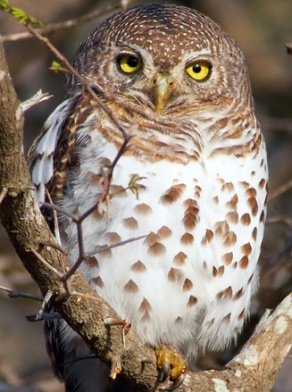
African Barred Owlet
Description: The African Barred Owlet (Glaucidium capense) is a species of owl in the Strigidae family. With a length of 20-21 cm and a weight of 83-140 grams it is a small owl. It has no ear tufts. There is some sexual dimorphism in size, with the females being larger, but no differences in plumage.Behaviour: The species is most frequently found in woodland and forests, and on forest edges. It may also occur in more open savannah and along rivers
Food: It is partly diurnal, and feeds mostly on insects, although small rodents and birds may also be eaten.
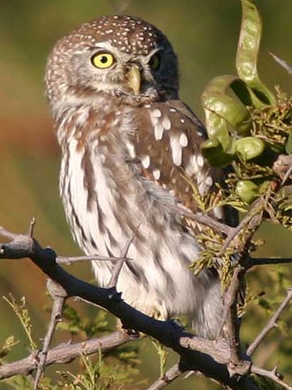
Pearl-Spotted Owlet
Description: The Pearl-spotted Owlet is a small 19cm and stocky, with a longish tail. The upper parts are rich brown, heavily spotted with white. The underparts are white, streaked with brown. The facial disc is white and the eyes are yellow. There are two eyespots on the nape.
Food: This species often hunts by day, and can be readily located by the small birds that mob it while it is perched in a tree. It hunts a variety of small prey.
Breeding: It nests in a hole in a tree, such as a disused barbet nest, laying 2-4 eggs.
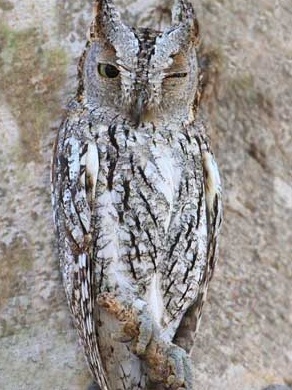
African Scops-Owl
Description: The African Scops-Owl is a slender, little eared owl, with two forms, grey or rufous-grey all over. With a length of 17-20cm and a weight of 45-120grams it is a small owl.Behaviour: During the day, it roosts on a branch and stands upright, long and slender, with erect ear-tufts and closing to slit its eyelids. It often returns on the same site each day for roosting, among tangled branches, or in the open against a vertical branch where it is very difficult to see it. At night, it's head appears rounded, with ear-tufts tucked away.
Food: They mainly feed on small animals such as cockroaches, mole crickets, mantises, lizards, worms, spiders, moths and larvae.
Breeding: African Scops-Owl nest in tree cavities, in natural holes, cities in fence poles, buildings and nest-boxes. They often use holes 200-500mm deep, with vertical entrance. Female lays 4-6 eggs from April to June, toward the end of rains, when food resources become abundant with insect outbreak. Incubation lasts about 25-27 days, by female, while male remains invisible concealed some distance away. Male feeds female during this period. Young are fed by both adults, with a high feeding temp, about 66 times in seven hours at night. Young leave at about one month of age.